 Lycopene Institute
TorusFold-Hybrid · Structure
A physics-based pipeline for long circular RNA. Anyone can read this page; submitting a job needs a key. One job runs at a time, and a long chain legitimately takes hours to days.
Interactive structure viewer
The model below is a 2,013 nt circular RNA with 42,831 atoms. It has no 5′ or 3′ end; the two ends are covalently joined.
This molecule has never been solved experimentally. Every atom you see was computed.
Outputs
All-atom model
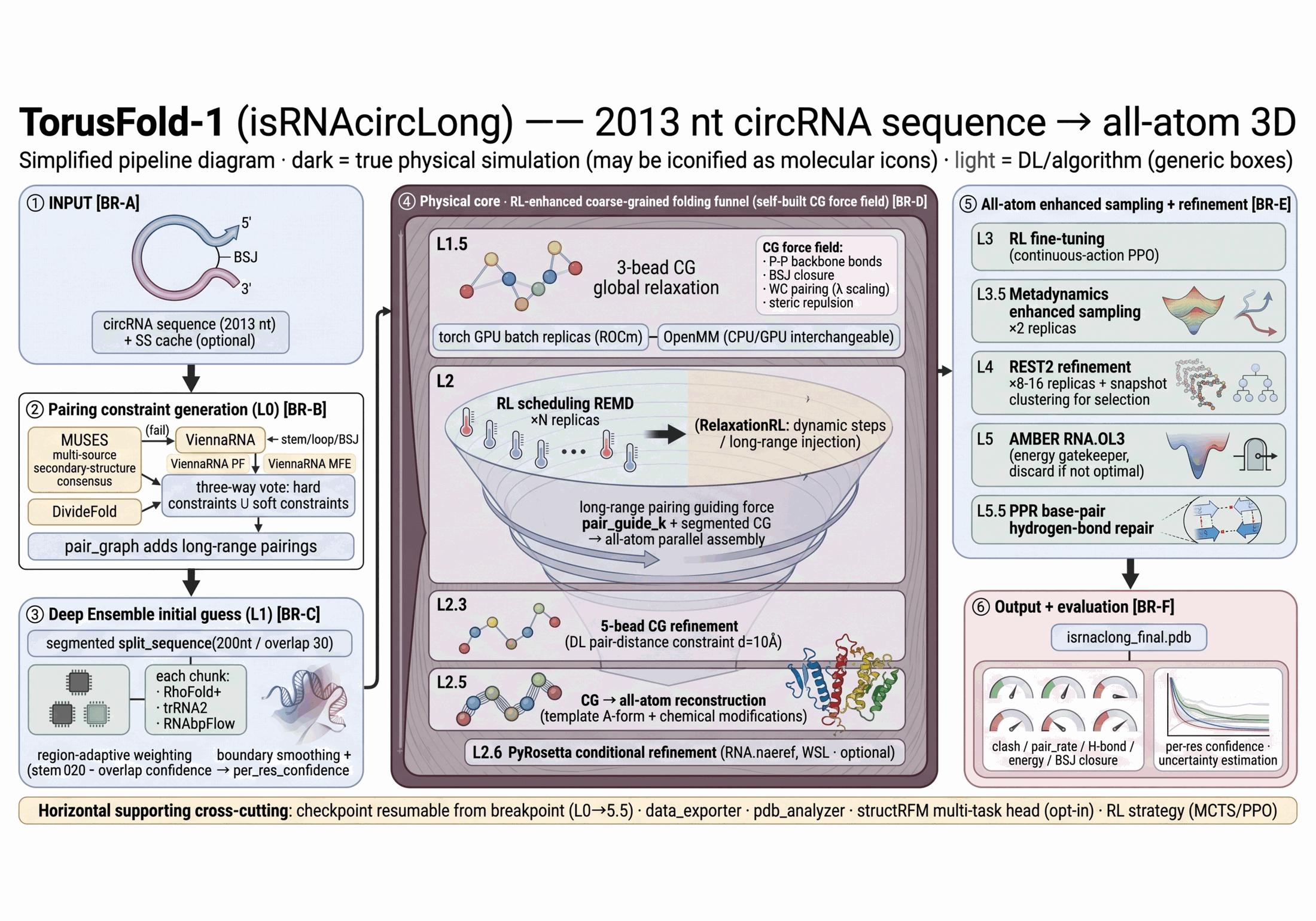
Coarse-grained ring closure → replica exchange and metadynamics → PPR base-pair repair → 1EHZ-templated all-atom rebuild → restrained Amber14-OL3 refinement.
Download PDB · quality.json · provenance.json · sequence.txt
2OIU
The only fully solved circular RNA structure; it serves as the reference for the whole pipeline. Force-field relaxation from the crystal ends at RMSD 1.83 Å in 17 minutes.
Submit a job
Anyone can read this page; submitting needs a key. Keys come from the site owner. One job runs at a time (a long chain legitimately takes hours to days).
Three things:
- One job at a time, and a long chain honestly takes hours to days. Submitting needs a key, and you can end your own job afterwards.
- Its own console is open too: open it → You can submit from there as well — just log in with your key on this page first. Length bounds, parameter ranges and the one-job-at-a-time rule are the same on both.
- Scoring and feedback both work in the console — to score a structure or leave feedback, just log in with your key on this page first. Only “install dependencies” stays closed: that installer is meant for people setting up their own machines.
0 nt
job
Run it yourself: the command line
This page is only a front end. The repository is a complete command-line pipeline — install it on your own machine and it runs without this site, without a key, and without the length bound enforced here.
git clone https://github.com/RomanCohort/Torusfold-physics
cd Torusfold-physics
pip install -e .                         # optional extras: [gpu] [ml] [plot] [pyrosetta]
conda install -c conda-forge viennarna   # secondary structure needs ViennaRNA (or pip install '.[ss]')
# put the sequence in sequence.txt (plain text; T is read as U)
python run_2013nt.py
# -> output_2013nt/isrnaclong_final.pdb
python serve.py
# default 8877, then open http://127.0.0.1:8877
# live log (SSE) + Predict API + 3Dmol viewer
GET  /api/health   is it alive
POST /api/predict  {sequence, params}  -> returns a job_id immediately
GET  /api/current  what the current job is doing
Let your assistant drive it: the repository ships a skill
The repository ships an agent skill: one copy per harness, identical bodies, differing only in frontmatter — .claude/skills/torusfold-predict/SKILL.md (Claude Code) and .dsh/skills/torusfold-predict/SKILL.md (DeepSeek Harness). tests/test_skills_in_sync.py fails in CI if the two drift apart.
It is written for the assistant, not for a person: the assistant asks you for the sequence and does everything else — decides whether the question is answerable, starts the tool, picks the settings, watches the run, and translates the numbers back into your vocabulary. It even forbids handing you a command to run, a choice of parameters, or a number standing on its own.
It also encodes the one way this tool hands a biologist a confidently wrong answer: below about 30 nt every stage runs to completion and returns a structure that is not a ring, with nothing in the output saying so. So the assistant checks the length before spending hours of your time.
A command line you can try without installing anything
With a key this is a real terminal — commands run on the owner's dev machine through a small agent there (read-only allowlist, 20 s timeout, paths locked inside the repository). Without a key it is a demonstration: what can reach the backend does, the rest is tagged [simulated], and nothing pretends to have run.
Knobs
Figures
Method
Circular RNA has no 5′/3′ ends, so ordinary linear folding algorithms do not apply directly.
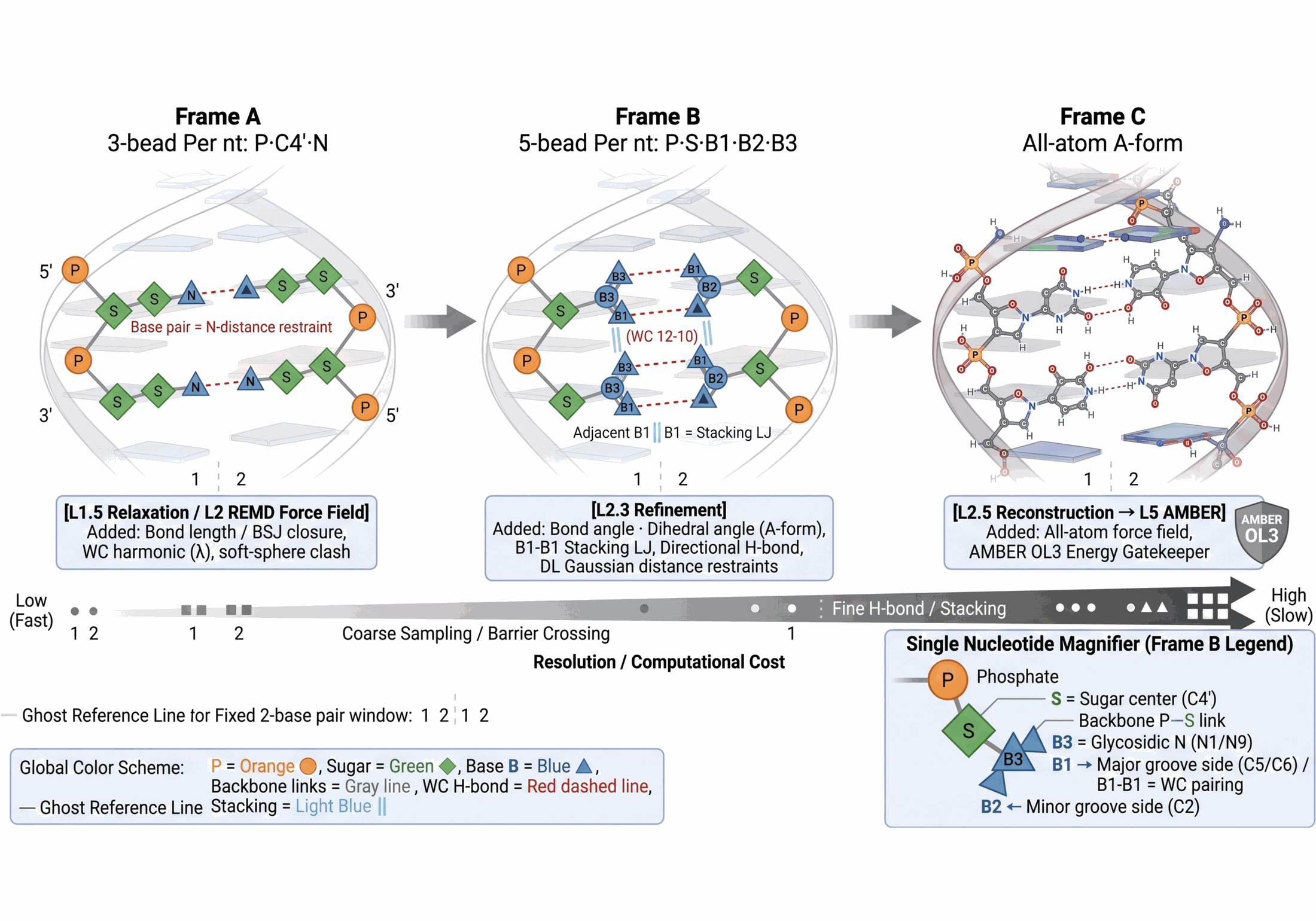
We write down an energy function first: bond lengths, angles, dihedrals, stacking, base pairing, excluded volume, plus the closure term unique to a ring. The structure is the lowest-energy conformation of that field. The constants are not guesses either — the adjacent-phosphate bond length is the mean measured over 6,638 real structures, and the stiffnesses come from kBT over the measured fluctuations.
Then comes sampling, the hard part. Closing a long chain into a ring means crossing a tall barrier, so replica exchange (REST2) and metadynamics flatten it a little.
Known limits
Below roughly 30 nt the ring does not close, yet the software still runs every stage and returns a structure that is not circular, with no warning. That is why the lower bound here is 30 nt.
This demonstration construct has no wet-lab validation; the output is a physical hypothesis, not a measurement.